


Send Message
Privacy statement: Your privacy is very important to Us. Our company promises not to disclose your personal information to any external company with out your explicit permission.

FARIZON MOTOR TECHNOLOGY CO.,LTD
There are huge differences in wind and waves, load capacity, and endurance requirements in different water areas. First determine the navigation area and then lock in the power range.
1. Inland waterway vessels (cargo barges, inland bulk carriers, small sand mining ships)
The Yangtze River, the Pearl River and other inland rivers have gentle water flow and limited navigable draft. The FARIZON high-speed four stroke ship engine is preferred, with a rotating speed of 1800-2200 rpm and a power of 150-400 horsepower. Compact body with small cabin space, suitable for small and medium-sized inland waterway cargo ships and push barges. Short distance daily round-trip navigation with minimal load fluctuations can be met by conventional freshwater cooling models, resulting in lower procurement and maintenance costs.
2. Offshore fishing boats and coastal short haul transport ships
Offshore wind and waves are strong, and ships are loaded with fishing or cargo all year round, requiring medium speed and high torque models with 400-600 horsepower range, low-speed output of strong thrust, anti wave climbing without stuffiness. The high salt spray environment in seawater requires the use of a complete anti-corrosion upgraded version, suitable for continuous offshore operations for more than 12 hours per day.
3. Engineering special vessels (tugboats, dredgers, offshore workboats)
Tugboards and sand mining vessels are operating under heavy and variable load conditions for a long time, with priority given to marine engines with continuous power. They are allowed to operate at 100% full load for a long time, with sufficient torque reserves and frequent acceleration and deceleration without power attenuation, to avoid long-term overload acceleration and cylinder wear.
4. Large ocean going transport ships and passenger ferries
For long-distance cross sea navigation, it is recommended to use a high-power medium speed diesel/methanol dual fuel engine, paired with a closed central cooling system, for long endurance and stable fuel consumption. It is suitable for long-term constant speed cruising across the ocean and meets international IMO emission standards.
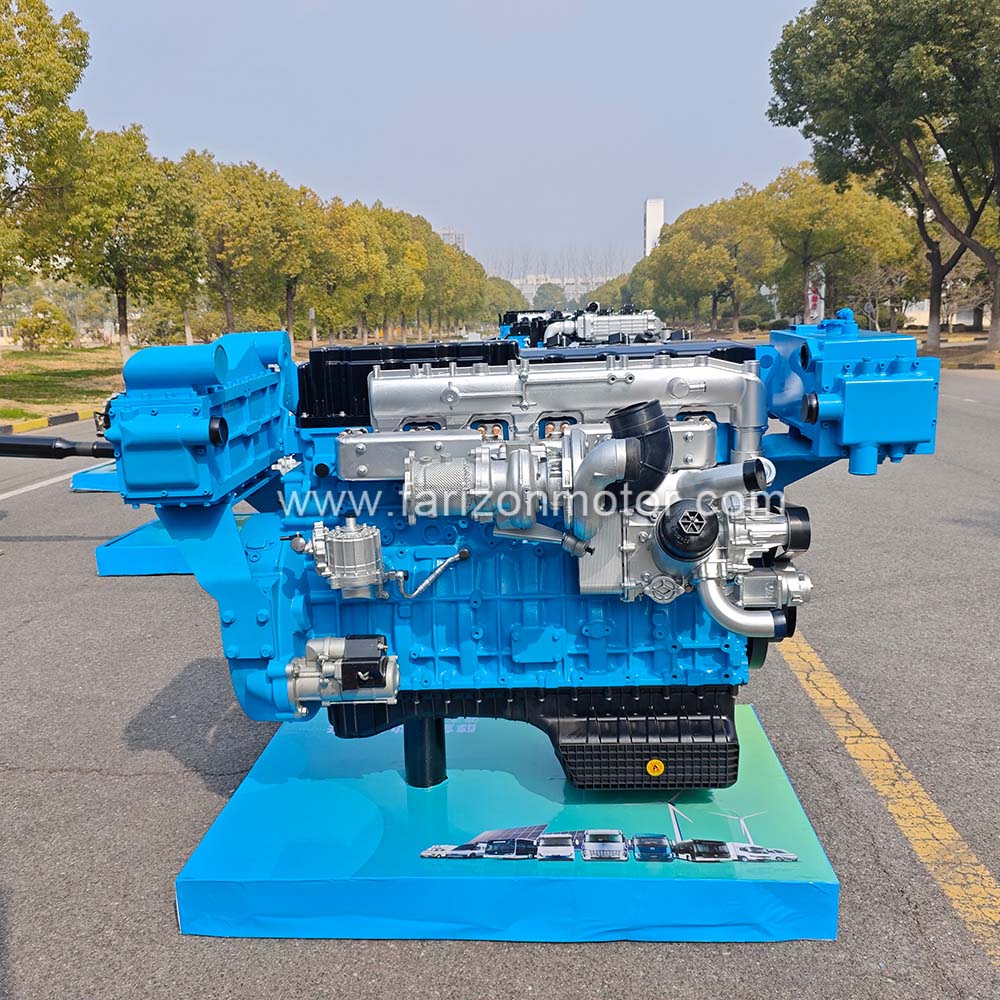
The power of ship engines is divided into two standards, which are the core selection points for avoiding pitfalls in Weichai Heavy Machinery Common power: suitable for inland short distance ships that operate for less than 8 hours a day and occasionally have short-term full load, with an overload of 1 hour every 12 hours; Continuous power: Supports 100% rated load continuous operation around the clock. Fishing boats, tugboats, and ocean going vessels must choose this calibrated model. Many land to sea conversion ship engines are only labeled with peak horsepower and do not have continuous power certification, making them prone to high temperature power limitation when going out to sea for a long time. All FARIZON ship engines are calibrated according to maritime standards for power, distinguishing between main engine propulsion and auxiliary engine power generation models, to prevent fuel consumption spikes and premature scrapping of machinery caused by small horses pulling large vehicles.
1. Chloride ions in seawater can quickly corrode cylinder liners and pipelines, and the cooling scheme directly determines the service life of the engine.
2. Pure inland freshwater navigation: Choose the open freshwater cooling basic model, which has a simple structure and cheap maintenance;
3. Offshore and coastal waters: It is mandatory to choose a closed central cooling system, where seawater does not directly contact the engine body. The heat exchanger is made of salt spray resistant and anti-corrosion materials, and the entire machine's pipelines and cylinder body are coated with galvanized anti-corrosion coating to reduce salt spray erosion and leakage;
4. High temperature tropical waters and northern low-temperature waters: Customizable low-temperature preheating and high-temperature heat dissipation enhancement modules can be used to maintain stable temperature control under extreme temperatures and prevent shutdown faults.
Traditional diesel ship engine
Suitable for all navigation areas, with full coverage of refueling points and fast power response, it is suitable for remote offshore and long-distance routes without Clean energy supply. The aircraft model is mature and the global spare parts supply is complete, making it the mainstream choice for small and medium-sized fishing boats.
FARIZON methanol dual fuel ship engine
Liquid clean fuel, burns without particulate matter, meets the strict emissions requirements of IMO Tier III, and can freely enter and exit environmentally controlled ports and inland green waterways; The fuel cost is about 30% lower than diesel, making it suitable for inland and coastal transport ships with fixed routes and ports equipped with methanol refueling facilities. Shortboard requires a dedicated storage pipeline and is not recommended for routes without refueling stations.
Both domestic and foreign ship inspections require mandatory verification of engine qualifications, and unlicensed ships cannot be registered, sailed, or cleared through customs. Domestic inland/offshore vessels: require CCS ship inspection certification and China's Phase II/III ship emission certificate; Exporting overseas ocean going vessels: must pass the IMO Tier III international maritime emission certification, accompanied by the IAPP pollution prevention certificate, and meet the environmental inspection requirements of ports in Southeast Asia, the Middle East, Europe, and America. FARIZON's full range of marine power has completed a complete set of maritime certification, with complete certificate materials attached to the factory. Shipowners can directly handle ship inspections without additional rectification.
1. Small inland river fleet with an annual sailing time of less than 6000 hours: choose medium and small horsepower high-speed diesel ship engines, with low initial investment, universal accessories, and multiple maintenance outlets;
2. Offshore fishing, tugboats, and year-round high load vessels: Priority should be given to anti-corrosion strengthened medium speed models. Although the purchase price is high, the annual anti-corrosion maintenance expenses should be reduced, and the price difference can be recovered within 3 years;
3. Large shipping companies with fixed routes and pursuit of low-carbon cost reduction: Bulk use of methanol dual fuel ship engines, significant long-term fuel savings, and adaptation to green ship subsidy policies.
The selection of FARIZON marine engines follows four core logics: fixed power and anti-corrosion configuration for inland/nearshore/offshore navigation areas; Distinguish continuous/common power based on daily homework duration; Choose diesel or methanol fuel according to the dock supply conditions; Matching navigation areas with corresponding CCS and IMO maritime certifications. High speed freshwater cooled Diesel Engines are selected for short distance inland transportation, anti-corrosion medium speed engines are equipped for offshore heavy-duty ships, and methanol dual fuel engines are preferred for fixed and environmentally friendly routes. FARIZON marine power combines reliability, low energy consumption, and global compliance standards, providing a one-stop green ship power solution for main engine propulsion and marine generator sets.
Q1: Can inland ships directly purchase land diesel engines and retrofit them onto the ship?
A1: Not recommended. Land power has no anti-corrosion or marine cooling design, no maritime certification, and is prone to corrosion and damage in the short term, making it impossible to pass ship inspections.
Q2: Do offshore fishing vessels have to use closed cooling ship engines?
A2: Yes, direct seawater cooling can quickly corrode cylinder liners and pipelines, while closed central cooling can significantly extend the service life of the engine.
Q3: Is methanol ship engine suitable for long-distance and cross sea navigation?
A3: Only applicable to fixed routes with methanol refueling stations along the way; Insufficient ocean supply facilities, priority given to traditional diesel ship engines.
Q4: Which power calibration should be considered for tugboats and sand mining ships?
A4: Marine engines with continuous power rating must be selected to meet the requirements of long-term full load and variable operating conditions.
Email to this supplier
Privacy statement: Your privacy is very important to Us. Our company promises not to disclose your personal information to any external company with out your explicit permission.
Fill in more information so that we can get in touch with you faster
Privacy statement: Your privacy is very important to Us. Our company promises not to disclose your personal information to any external company with out your explicit permission.