


Send Message
Privacy statement: Your privacy is very important to Us. Our company promises not to disclose your personal information to any external company with out your explicit permission.
FARIZON MOTOR TECHNOLOGY CO.,LTD
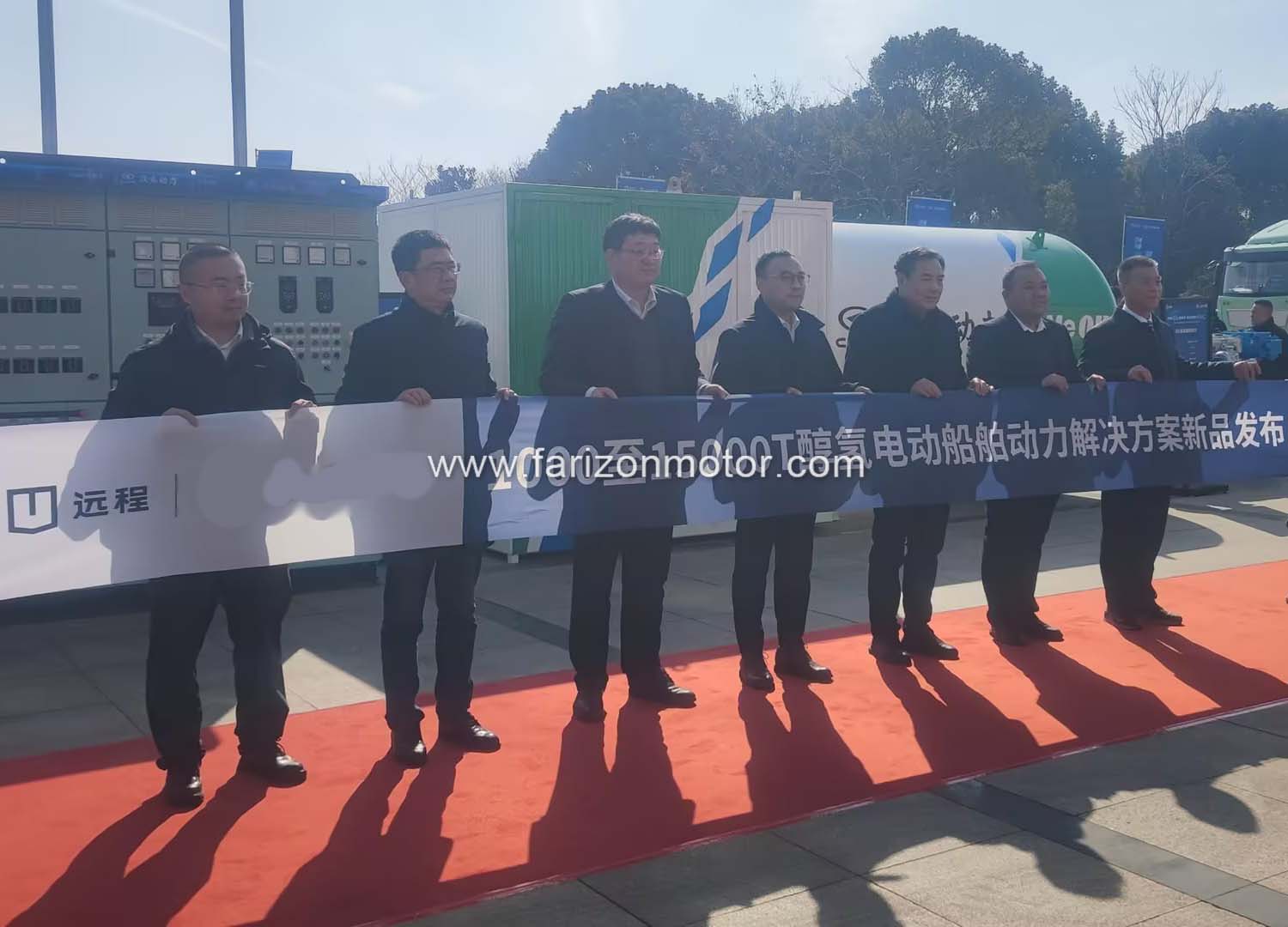
At the press conference, a red carpet was laid out, and the main visual banner clearly marked "New Product Release of 1000 to 15000T Alcohol Hydrogen Electric Ship Power Solution", appearing alongside the dual brands of Hanma Technology remotely. On one side, core equipment such as Hanma Power Unit was displayed, and on the other side, New Energy heavy-duty trucks were parked, forming an integrated technology display of "vehicle machine ship". The company's management and partners jointly unveiled the new product, announcing the official landing of alcohol hydrogen electric in the field of ship power.
Alcohol hydrogen electric "is not a traditional single Fuel engine, but a range extender electric system using methanol as the energy carrier. The core logic is to replace high-pressure hydrogen with liquid methanol, convert methanol and water into hydrogen rich gas through a ship mounted reforming device, and then generate electricity from the power unit and drive the electric motor for propulsion. Compared to high-pressure hydrogen routes, liquid methanol storage and transportation are more convenient, and the energy replenishment method is closer to traditional fuels, making it more suitable for long-distance and high-power ship operating conditions. In the ship scenario, this scheme adopts multiple alcohol hydrogen units connected to the grid for power generation, and flexibly configures power according to the tonnage and speed requirements of the ship type.
The solution released this time covers ships ranging from 1000 to 15000 tons, forming a relatively complete tonnage spectrum. For different ship types, modular combinations are proposed in terms of unit quantity, power configuration, and storage and supply systems: small and medium-sized ships are matched with fewer units, while large bulk carriers and container ships can have multiple machines connected in parallel and powered in stages. The idea of "determining power according to tonnage and matching units according to operating conditions" enables alcohol hydrogen electric vehicles to adapt to various shipping scenarios such as inland waterway freight, coastal transportation, and engineering operations, providing optional technical paths for shipowners of different scales.
Alcohol hydrogen electric vehicles have practical application foundations in the field of ships. Previously, the world's first methanol electric distribution ship "Yuanchun 001" has been put into commercial operation in Shanghai, and promoted in the Yangtze River, the Pearl River, Huaihe River, Beijing Hangzhou Grand Canal and other major inland river systems; At present, there are dozens of alcohol hydrogen electric ships being launched or under construction in major inland river systems across the country, and the number of planned constructions continues to increase. The release of the 1000 to 15000 ton solution this time is a further expansion towards larger tonnage and wider water areas based on existing inland river practices.
Behind the electrification of ship power is the continuous pressure on global shipping emissions reduction. The International Maritime Organization (IMO) and domestic shipping green and low-carbon transformation policies have put forward higher requirements for ship carbon emissions. Methanol is regarded as one of the important alternative fuels in the industry due to its cleanliness, liquid state at room temperature, and convenient storage and transportation. In this context, as a fusion route of "methanol+electric", alcohol hydrogen electric provides a technological choice for the shipping industry that balances endurance and emission reduction, and also opens up new application space for engine manufacturers.
For FARIZON, this release is not only the launch of a single product, but also a systematic extension of the technology landscape from highways to water bodies. Starting from commercial vehicles, alcohol hydrogen electric vehicles gradually cover multiple scenarios such as Generator sets and ship power, forming a "land water" collaborative technological layout. With the implementation of the 1000 to 15000 ton plan, alcohol hydrogen electric vehicles are expected to occupy a place in the wave of green shipping industry.
From the unveiling of dual brands at the press conference, to the complete spectrum covering 1000 to 15000 tons, and to the continuous practice of inland waterway transportation, FARIZON is using alcohol hydrogen electric as a pivot to promote green power from land to water. In the future, with the continuous iteration of technology and the expansion of application scenarios, alcohol hydrogen electric vehicles may play an increasingly important role in the process of reducing emissions in shipping.
Email to this supplier
Privacy statement: Your privacy is very important to Us. Our company promises not to disclose your personal information to any external company with out your explicit permission.
Fill in more information so that we can get in touch with you faster
Privacy statement: Your privacy is very important to Us. Our company promises not to disclose your personal information to any external company with out your explicit permission.