


Send Message
Privacy statement: Your privacy is very important to Us. Our company promises not to disclose your personal information to any external company with out your explicit permission.

FARIZON MOTOR TECHNOLOGY CO.,LTD
Priority should be given to setting up an independent machine room for the generator set, away from densely populated rooms and office areas, avoiding low-lying areas with accumulated water, and preventing water from entering during the rainy season. Outdoor use requires the selection of a rainproof protective shelter, which cannot be directly placed outdoors. The computer room should be as close as possible to the load end, shorten the distance of output cables, reduce voltage loss, and stay away from areas where flammable and explosive materials are stored.
It is recommended to use a concrete special foundation for the unit foundation, with the foundation height reserved according to the size of the machine model and leveled horizontally. Isolation treatment should be carried out between the foundation and the building walls to avoid the transmission of engine vibration to the main body of the building, which may cause wall resonance noise. The width of the machine room door should meet the requirements for lifting the entire machine and replacing parts in the later stage. Equipment access channels should be reserved. Small units can be placed indoors, while high-power units are recommended to be arranged in a semi open or square cabin style.
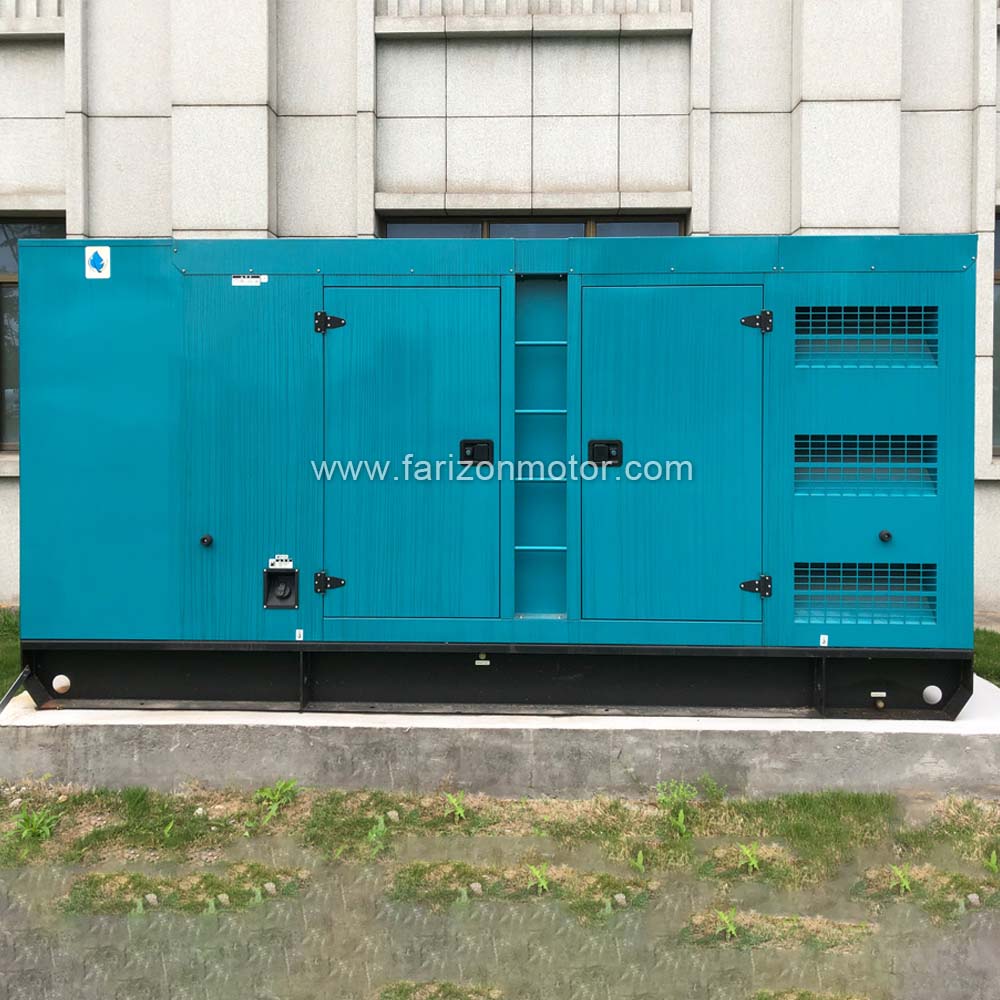
Heat dissipation is of utmost importance in the layout work. The operation of diesel generator sets generates a large amount of heat, and insufficient ventilation can directly cause high water temperature, power attenuation, and even protective shutdown. The computer room needs to be equipped with separate air inlet and exhaust outlet, which should be arranged separately to avoid hot air backflow. The air inlet should be close to the inlet side of the unit radiator, introducing outdoor cold air; Align the exhaust outlet with the radiator outlet and direct the hot air outdoors.
The air outlet area needs to match the cooling air volume of the unit, and too small louvers cannot be installed to prevent ventilation obstruction. Adjustable air doors can be installed on the ventilation openings of computer rooms in high-altitude areas, and some air vents can be closed in low-temperature environments for quick warming up; In the high-temperature southern environment, it is necessary to prevent the computer room from being sealed and install auxiliary exhaust devices if necessary. The FARIZON series generator sets provide reference parameters for ventilation air volume during the design phase, which facilitates the engineering party in designing the size of the air outlet.
Unreasonable arrangement of smoke exhaust pipes is a common fault point in the project. The exhaust pipe should be as short as possible, reducing the number of bends and lowering the exhaust back pressure. Excessive back pressure can directly lead to a decrease in engine power and an increase in Fuel consumption. Industrial mufflers must be installed on the pipeline, which are fixed on independent brackets. It is forbidden to directly press the weight on the engine exhaust manifold to prevent interface cracking and air leakage.
The outer layer of the pipeline is wrapped with a thermal insulation layer to prevent the temperature inside the computer room from rising and to prevent personnel from touching and scalding. The smoke exhaust outlet extends out of the exterior wall of the building, facing away from the personnel activity area. The pipe mouth slopes downwards at a small angle to prevent rainwater from flowing back into the cylinder. Seal the pipeline connection to prevent the backflow of exhaust gas into the machine room, which may pose a safety risk of carbon monoxide.
The fuel tank should be prioritized for placement outside the engine room. When conditions are limited and placed indoors, an anti-seepage oil pan should be installed. The slope of the oil pipeline is reasonable to avoid the interruption of oil supply caused by gas accumulation in the pipeline. The pipeline joints are sealed reliably to prevent dripping. Keep the fuel tank away from the high-temperature exhaust pipe and implement fire isolation measures.
Maintain a safe distance between the wiring of power output cables and the high-temperature exhaust pipes, arrange cable trays neatly, separate strong and weak electricity, and reduce signal interference. Try to keep the battery as close as possible to the unit, shorten the starting cable, reduce voltage drop, and equip emergency lighting inside the machine room for easy maintenance and operation.
Install shock absorbers between the unit base and foundation to weaken the transmission of operational vibrations. The inner wall of the computer room can be equipped with sound-absorbing materials to achieve noise reduction, and soundproof doors and windows are selected for the computer room. When arranging, maintenance space must be reserved around, with operating distance left on the engine side, radiator side, and in front of the control cabinet. It cannot be installed tightly against the wall, otherwise filter replacement and maintenance cannot be carried out later.
The core of the layout of diesel generator sets can be summarized as: site selection to prevent water accumulation, ventilation to ensure heat dissipation, smoke exhaust to control back pressure, oil circuit leakage prevention, and reserved maintenance space. A high-quality unit cannot achieve its rated performance if the on-site layout is not reasonable. FARIZON engines can provide customers with matching layout reference solutions, tailored to different working conditions such as site backup, factory emergency, ship auxiliary equipment, and off grid power stations. They provide recommendations for the layout of the output machine room to avoid common installation errors and ensure the long-term stable and reliable operation of the generator set.
Email to this supplier
Privacy statement: Your privacy is very important to Us. Our company promises not to disclose your personal information to any external company with out your explicit permission.
Fill in more information so that we can get in touch with you faster
Privacy statement: Your privacy is very important to Us. Our company promises not to disclose your personal information to any external company with out your explicit permission.