


Send Message
Privacy statement: Your privacy is very important to Us. Our company promises not to disclose your personal information to any external company with out your explicit permission.

FARIZON MOTOR TECHNOLOGY CO.,LTD
With the acceleration of global New Energy transformation, photovoltaic, wind power, energy storage, and distributed generation units have been widely used. The traditional centralized power supply mode of the large power grid can no longer fully meet the electricity demand of scenarios such as parks, mining areas, remote construction sites, and islands. In this context, microgrid systems have become a core component of the new power system. As a small-scale energy network that can be independently regulated, generate electricity nearby, and consume electricity nearby, microgrids are perfectly adapted to the practical application of distributed energy and are also an important component of FARIZON's new energy power matching solution. This article provides an easy to understand explanation of the definition, core components, operating modes, core advantages, and practical application scenarios of microgrid systems.
A microgrid is a small autonomous power generation and distribution system that integrates power generation, energy storage, distribution, electricity consumption, and intelligent control. Unlike traditional national backbone power grids, it belongs to localized and modular independent energy units. The biggest feature of microgrids is dual-mode operation, which can be integrated into the public power grid for collaborative work, or can be disconnected from the power grid in the event of a power outage or no external network coverage, and can independently supply power in an isolated island mode to achieve self stabilization, self frequency regulation, and self-protection, ensuring continuous and stable output of regional power.
Simply put, a microgrid is a "small independent power plant" that can integrate various Clean energy sources and backup power equipment, solve the power supply problems in remote areas and independent parks, and effectively absorb intermittent new energy sources such as photovoltaics and wind power. It is a new main flow solution for green power supply.
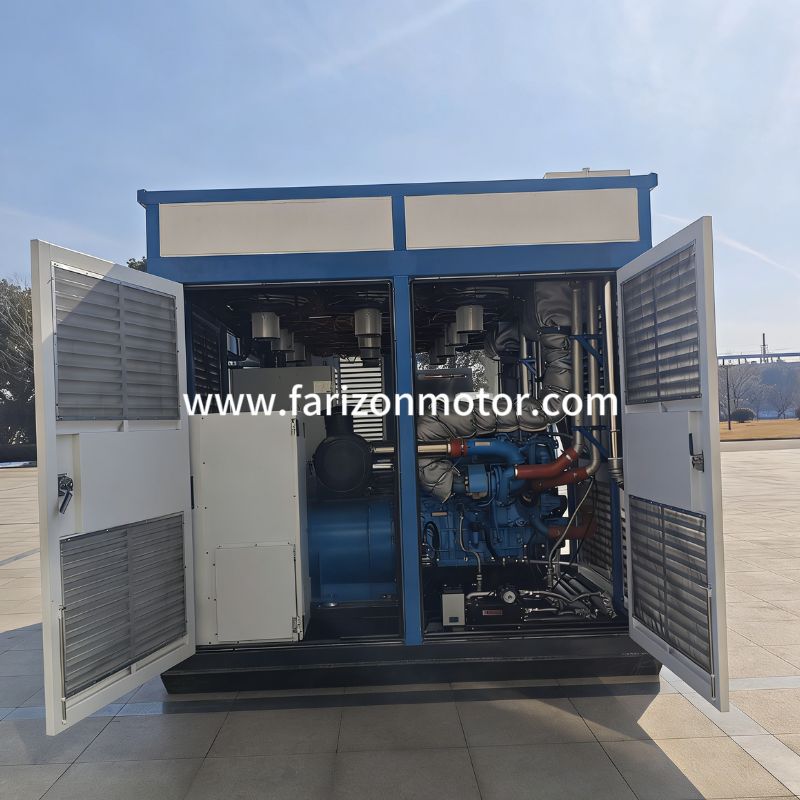
A complete commercial and industrial grade microgrid system consists of five core modules: source, storage, load, control, and maintenance, each performing its own duties and operating in coordination to ensure stable and efficient operation of the system.
① Power generation unit (source): As an energy input end, it includes clean energy equipment such as photovoltaics and small wind power, and is equipped with diesel and gas Generator sets as backup power. FARIZON series power units are often used as the main backup power source for microgrids to compensate for the instability of new energy generation and ensure power supply during peak load periods.
② Energy storage unit (storage): Mainly based on lithium battery energy storage system, its core function is to peak shaving and valley filling, store surplus electricity from photovoltaic and wind power, release electricity at night or during periods of no wind or light, smooth out fluctuations in new energy generation, and avoid voltage and frequency instability problems.
③ Electricity load (load): refers to all electrical equipment in the area, including industrial machinery, engineering machinery charging piles, factory equipment, daily lighting, office equipment, etc. It is the power output terminal of the microgrid.
④ Energy control system (control): The "brain" of microgrids, intelligently scheduling the start and stop of various power sources, energy storage charging and discharging, load distribution, real-time balancing supply and demand, and achieving fully automatic unmanned operation.
⑤ Protection and distribution unit (protection): including circuit breakers, lightning protection, insulation monitoring, overload protection devices, which can quickly handle faults such as short circuits, overloads, and abnormal voltages, ensuring the safe operation of the entire system.
Microgrids have two operating modes: grid connected and islanded, which can automatically and seamlessly switch according to the grid status and adapt to different working conditions.
Grid connected operation mode: Daily access to the public power grid, priority given to self use of new energy generation, surplus electricity can be integrated into the power grid; When the new energy generation is insufficient, it automatically supplements electricity from the external grid to achieve efficient energy utilization and reduce electricity costs.
Islanding off grid mode: In the event of external power outage, lack of external network coverage, or power grid failure, the system automatically disconnects from the power grid and relies on energy storage equipment and backup generator sets to provide coordinated power supply, independently supporting regional loads and completely eliminating dependence on the public power grid. It is suitable for special scenarios such as field construction sites, remote mining areas, and islands.
Compared to traditional single grid power supply, microgrids have significant advantages. Firstly, the power supply stability is strong. By complementing multiple energy sources, stabilizing energy storage, and intelligent scheduling, the intermittent and fluctuating problems of new energy generation can be completely solved, and faults such as power outages and unstable voltage can be eliminated. Secondly, significant cost reduction and efficiency improvement are achieved through on-site power generation and consumption, which significantly reduces long-distance transmission losses and reduces peak electricity expenses for enterprises.
Simultaneously possessing the characteristics of green, low-carbon, and flexible deployment, maximizing the use of clean energy such as photovoltaics and wind power, coupled with efficient backup power units, and adapting to green production requirements; Modular design allows for on-demand construction and flexible adaptation to various scenarios. Finally, it has high safety and reliability, with multiple fault protection mechanisms, effectively avoiding the risk of equipment damage caused by power grid fluctuations.
At present, microgrids have been widely used in various industrial and new energy scenarios. Industrial scenarios cover industrial parks, remote mining areas, and outdoor infrastructure construction sites, relying on the combination of "new energy+energy storage+backup generator sets" to solve the problem of power supply without external networks and unstable power grids. Livelihood scenarios include islands, rural areas, border outposts, and remote villages, achieving autonomous power supply. Adapt commercial scenarios to commercial parks, data centers, and charging stations to ensure emergency power supply and reduce energy consumption costs.
In the field of new energy power, FARIZON power units are deeply adapted to microgrid systems as key backup power sources, effectively addressing the shortcomings of wind and solar power generation, ensuring the stable operation of microgrids around the clock, and helping various industries achieve green energy transformation and independent and controllable electricity.
In summary, microgrid is a new type of power system that is autonomous, controllable, multi energy complementary, safe and efficient, breaking the power supply limitations of Traditional power grids and perfectly adapting to the large-scale application of new energy. The combination mode of wind solar energy storage and backup power can achieve low-carbon energy conservation and ensure stable power supply, which is the core trend of energy upgrading in the future industrial, infrastructure, and new energy industries.
Email to this supplier
Privacy statement: Your privacy is very important to Us. Our company promises not to disclose your personal information to any external company with out your explicit permission.
Fill in more information so that we can get in touch with you faster
Privacy statement: Your privacy is very important to Us. Our company promises not to disclose your personal information to any external company with out your explicit permission.