


Send Message
Privacy statement: Your privacy is very important to Us. Our company promises not to disclose your personal information to any external company with out your explicit permission.
FARIZON MOTOR TECHNOLOGY CO.,LTD
natural gas engines rely on clean gas to do work, with almost zero particulate matter emissions and lower noise, which is in line with strict environmental protection and traffic restrictions policies around the world. They are widely used in urban waste transportation, mainline logistics, mine dumping, public transportation and sanitation, and mixing station transportation. They are divided into two technical routes: CNG compressed natural gas and LNG liquefied natural gas. Different displacement and horsepower models have significant differences in range, power, gas consumption, and maintenance characteristics. If the selection does not match the operating conditions, problems such as insufficient range, weak climbing, high long-term gas consumption, and accelerated mechanical wear and tear may occur. FARIZON has created a complete product matrix for natural gas engines, covering a full range of light CNG, medium and heavy CNG, and large displacement LNG models. The scientific selection is based on five dimensions: operating route, load capacity, road conditions, refueling facilities, and long-term operating costs, which can balance power performance, energy-saving benefits, and equipment durability.
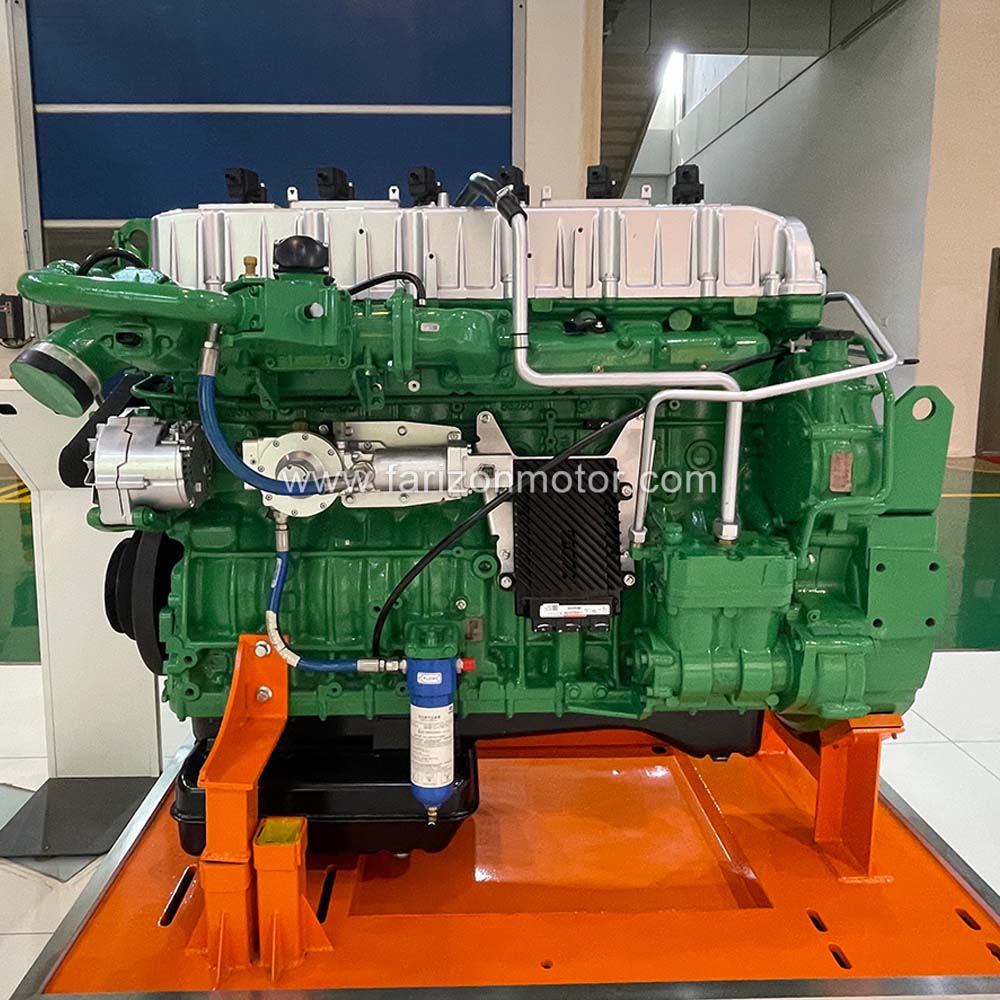
The FARIZON CNG model has a concentrated displacement of 7L-9L and a power coverage of 220-320 horsepower. It is equipped with high-pressure composite gas cylinders for energy storage, with a single range of 200-400 kilometers. The layout of gas filling points is dense, the filling speed is fast, the engine combustion conditions are mild, the post-treatment structure is simple, and no urea needs to be added. The daily maintenance parts are universal and the replacement cycle is longer. Suitable for urban short distance high-frequency start stop scenarios, including urban sanitation vehicles, small urban light trucks, urban waste dump trucks, suburban short distance mixer trucks, and buses, with a daily driving distance of less than 300 kilometers and fixed area cyclic operations. City fleets with sufficient refueling stations are given priority to choose CNG models, resulting in lower maintenance expenses throughout the entire cycle. The shortcoming of CNG models is limited energy storage density, which requires frequent energy replenishment for long-distance trunk transportation and is not suitable for long-distance transportation across provinces.
LNG liquefied natural Gas Engine
The FARIZON LNG model is mainly promoted with large displacements of 13L, 15L, and 16L, with a power of 430-600 horsepower. It is equipped with a vacuum insulated low-temperature storage tank, which has a storage capacity 2.5 times that of CNG in the same volume. The single endurance can reach 800-1200 kilometers, greatly reducing the frequency of refueling in the middle. It can output peak torque in the low-speed range and has sufficient power reserve for heavy-duty climbing. Suitable for 49 ton mainline tractor, 8 × 4 heavy-duty dump truck, large mixer truck, and mountainous resource transportation vehicle, suitable for long-distance travel over 500 kilometers per day across provinces and remote mining areas without dense gas filling network points. LNG Fuel is deeply purified, with less combustion impurities, slower engine carbon deposition rate, and stronger stability under high-intensity continuous transportation conditions; The only limitation is that the distribution of refueling stations is less than that of CNG, and the cost-effectiveness of short distance operations in urban core areas is relatively low.
Light duty conditions: urban light trucks, small sanitation (220-280 horsepower, 7L-9L CNG)
Lightweight body, with a total weight of less than 18 tons, on roads in plain urban areas, and for short distance light load transportation, choose a 220-280 horsepower small and medium displacement CNG Engine. The overall weight is small, the gas consumption is economical, and the power response is smooth under frequent start stop conditions of urban congestion. It is suitable for community renovation garbage removal and short distance distribution of building materials. The vehicle has flexible starting and long-term low-speed operation is not easy to produce carbon deposits.
Medium duty conditions: municipal waste soil, intercity mixing, medium truck (300-380 horsepower, 9L-11L CNG/LNG dual-use)
With a total weight of 25-32 tons, on suburban national highways and mild hilly road conditions, it can accommodate short distance urban and medium to short distance intercity transportation, and can flexibly choose CNG or small displacement LNG models. The torque output in the range of 300-380 horsepower is balanced, which can cope with weak power when starting on slopes or at full load. It is suitable for medium-sized mixer trucks and 6 × 4 dump trucks, taking into account urban greenway policies and short to medium distance transportation efficiency.
Heavy duty long-distance/mining heavy load: mainline traction, mining area self dumping (430-600 horsepower, 13L-16L LNG)
49 ton standard load mainline, continuous long slopes in mountainous areas, open-pit ore transportation, and 8 × 4 heavy-duty engineering vehicles must use 13L or above large displacement LNG engines. FARIZON high displacement gas engine can continuously output peak torque of 2100-2800N · m at 950-1400rpm, and does not slow down during heavy load climbing. Coupled with engine braking, it has lower braking losses during mountain driving, with a long oil change cycle of up to 100000-150000 kilometers. It is suitable for 24-hour uninterrupted high-intensity operation and avoids the problem of accelerated wear of components caused by long-term full load operation of small horsepower models.
Low speed and high torque are the core indicators for heavy-duty natural gas engines. For mainline and mining conditions, priority should be given to models with wider peak torque ranges to reduce frequent gear shifts and lower gas consumption; The use of vehicles in short distance cities on the plain can focus on lightweight and low gas consumption tuning models to control daily operating fuel expenses. In terms of environmental adaptation, FARIZON's entire range of natural gas engines come standard with a low-temperature starting system, which can stably ignite in cold and high-altitude areas at -30 ℃; Upgraded intake filtration and pipeline anti-corrosion structure for models in coastal high salt spray areas, equipped with multi-stage air filters in mining areas with high dust conditions, extending the replacement cycle of vulnerable parts such as spark plugs and throttle valves. All emission standards meet Euro VI and National VI standards, with no particulate matter emissions. It can freely enter urban environmental protection control zones and enclosed construction sites, enjoying the advantage of green passage. Compared with diesel vehicles, it saves maintenance steps such as DPF regeneration and urea injection, and significantly reduces the number of failure points.
Short term small-scale urban vehicle fleet, annual mileage within 80000 kilometers, sufficient gas stations, priority given to CNG models, lower initial vehicle procurement investment, and cheaper maintenance parts; Long distance trunk lines, mining fleet, annual mileage exceeding 150000 kilometers, preferred high displacement LNG models. Although the initial purchase cost of vehicles is higher, the fuel unit price is 20% -30% lower than diesel for a long time, with longer single endurance and improved transportation efficiency. The equipment price difference can be recovered in 2-3 years, and the comprehensive cost advantage of the entire life cycle is significant. Natural gas engines do not have complex components such as diesel injection high-pressure fuel lines and particulate filters. The replacement cycle of spark plugs and three-way catalytic converters is long, and the annual maintenance cost is reduced by more than 25% compared to Diesel Engines under the same operating conditions. It is suitable for large-scale bulk procurement of fleets.
Urban sanitation, short distance urban distribution, and small dump trucks in urban areas: 7L-9L 220-280 horsepower CNG natural gas engine; Medium sized mixer truck, suburban soil, intercity short to medium distance freight: 9L-11L 300-380 horsepower CNG/small displacement LNG engine; Mainline container tractor, 49 ton long-distance green road: 13L-15L 430-530 horsepower LNG natural gas engine; Open pit mines, heavy-duty self dumping in mountainous areas, and large-scale engineering transportation: 15L-16L 550-600 horsepower high displacement LNG natural gas engine.
The selection of natural gas engine cores follows the three principles of "fuel type based on mileage, fixed displacement horsepower based on load and road conditions, and full cycle cost accounting based on operating scale". CNG models are selected for short distance urban circulation operations, and large displacement LNG models are selected for long-distance heavy-duty and remote mining transportation; Plain light load matching small and medium horsepower models, mountainous and steep slope heavy load priority high displacement wide torque LNG models. FARIZON's full range of natural gas engines covers light, medium, and heavy operating conditions, supporting the adaptation of dump trucks, tractor trucks, mixer trucks, sanitation vehicles, and commercial vehicles of all categories. We provide one-stop services for power chain matching, customized calibration of operating conditions, and global after-sales maintenance, providing low-cost, low emission, and highly reliable green power solutions for logistics and engineering enterprises at home and abroad.
How to choose between CNG and LNG engines?
Select CNG within a daily average of 300 kilometers, on fixed urban routes, and at densely packed refueling stations; Choose LNG for daily average of over 500 kilometers, long-distance travel across provinces, and remote mining areas, with longer endurance and better long-distance gas consumption.
What horsepower natural gas engine should be selected for heavy-duty transportation in mountainous areas?
Recommended for mountainous heavy-duty and 49 ton standard load trunk lines is a 480-600 horsepower 13L-16L LNG engine with low speed and high torque, providing ample power for continuous uphill climbing.
What are the maintenance advantages of natural gas engines compared to diesel engines?
Almost no particulate matter emissions, no need for DPF or urea system, low post-treatment failure rate; Mild combustion, minimal cylinder wear, longer oil change intervals, and lower overall maintenance costs.
Is FARIZON natural gas engine suitable for low temperatures and harsh mining environments?
The entire series comes standard with a low-temperature starting device, which can start normally at -30 ℃; Upgrade the mining area version with multi-stage air filtration and anti-corrosion pipelines, suitable for complex working conditions with multiple dust and high salt spray.
Is natural gas engine suitable for mixer trucks and dump trucks?
Adaptation: CNG is suitable for short distance mixing and slag transportation in urban areas, while LNG is suitable for long-distance heavy-duty transportation of sand, gravel, and ores, meeting the dual needs of environmental protection restrictions and heavy-duty power.
Email to this supplier
Privacy statement: Your privacy is very important to Us. Our company promises not to disclose your personal information to any external company with out your explicit permission.
Fill in more information so that we can get in touch with you faster
Privacy statement: Your privacy is very important to Us. Our company promises not to disclose your personal information to any external company with out your explicit permission.